Single jersey explained
Sep 12, 2026
Short answer: Single jersey is the most common knitting technique in T-shirts. It has a smooth front, a slightly more uneven back and curls at the edge if it is not sewn or finished with rib.
Smooth front, textured back
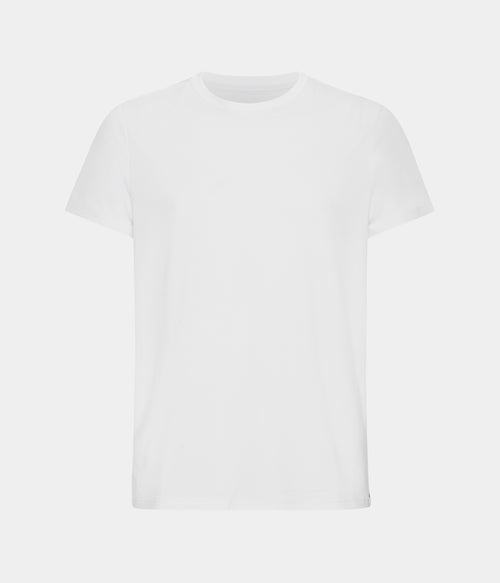
In single jersey, all stitches face the same way. That gives the smooth front with small V-shaped stitches you know from an ordinary T-shirt. The back has small loops instead and feels slightly rougher. The front faces outwards because it looks best and wears least. It is the fabric in many of the most popular for men.
It curls at the edge
A raw edge of single jersey curls up. The stitches pull unevenly on the front and back, so the fabric wants to roll over itself. That is why all edges are sewn or finished with a rib trim that keeps the fabric flat. Look at necklines and sleeves and you will see it clearly on the items in most popular at Copenhagen Bamboo.
Light and airy
Single jersey is the lightest of the common knitting techniques, because it is made of just one layer of stitches. That is why it is used for summer clothes, T-shirts and tops, and for the layer that sits right against the skin. The fabric breathes well and dries fairly quickly. See the styles in most popular for women.
Stretch across and along
Single jersey stretches more across the width than along the length. That is why a T-shirt gives around the chest and shoulders but keeps its length. Without elastane, the fabric does not fully recover after heavy stretching, so elbows and knees can develop a small bulge over time. With a little elastane, it springs back better.
Jersey and interlock
Interlock is two layers of jersey knitted together into one fabric. It is thicker and heavier, smooth on both sides and does not curl at the edge. Single jersey is lighter and more supple, but also more see-through in pale colours. The choice depends on what the garment is for and how much warmth you want.
Fit in single jersey
Because the fabric is light and supple, it sits close to the body and shows its shape. If you want a T-shirt that falls more loosely, you can go up a size. Keep in mind that a looser style also gets longer. Raise your arms when you try it on, so you can feel whether it still sits well.
Washing single jersey
Wash at 30 or 40 degrees on a gentle programme, ideally inside out. That protects the smooth front from rubbing in the machine. Skip the tumble dryer, because the heat can shrink the fabric and twist the edges. Ease the garment into shape while it is damp and hang it on a hanger to dry.
When the seams twist
A familiar effect with single jersey is that the side seams can move slightly around the body after a few washes. This comes from tension in the fabric from the knitting process. It happens least when the fabric is cut and sewn with care. You can reduce it by pulling the garment straight while wet and avoiding high heat.
Frequently asked questions
Why does the edge curl
Because the stitches pull unevenly on the front and back. It is a feature of the technique, which is why every edge is sewn or finished with rib so the fabric lies flat.
Does single jersey stretch a lot
More across than along. Without elastane the fabric does not fully recover after heavy stretching, but with a little elastane it finds its shape again more easily.
What is the difference between jersey and interlock
Interlock is two layers of jersey knitted together. It is thicker, heavier, smooth on both sides and does not curl, while single jersey is lighter and more airy.